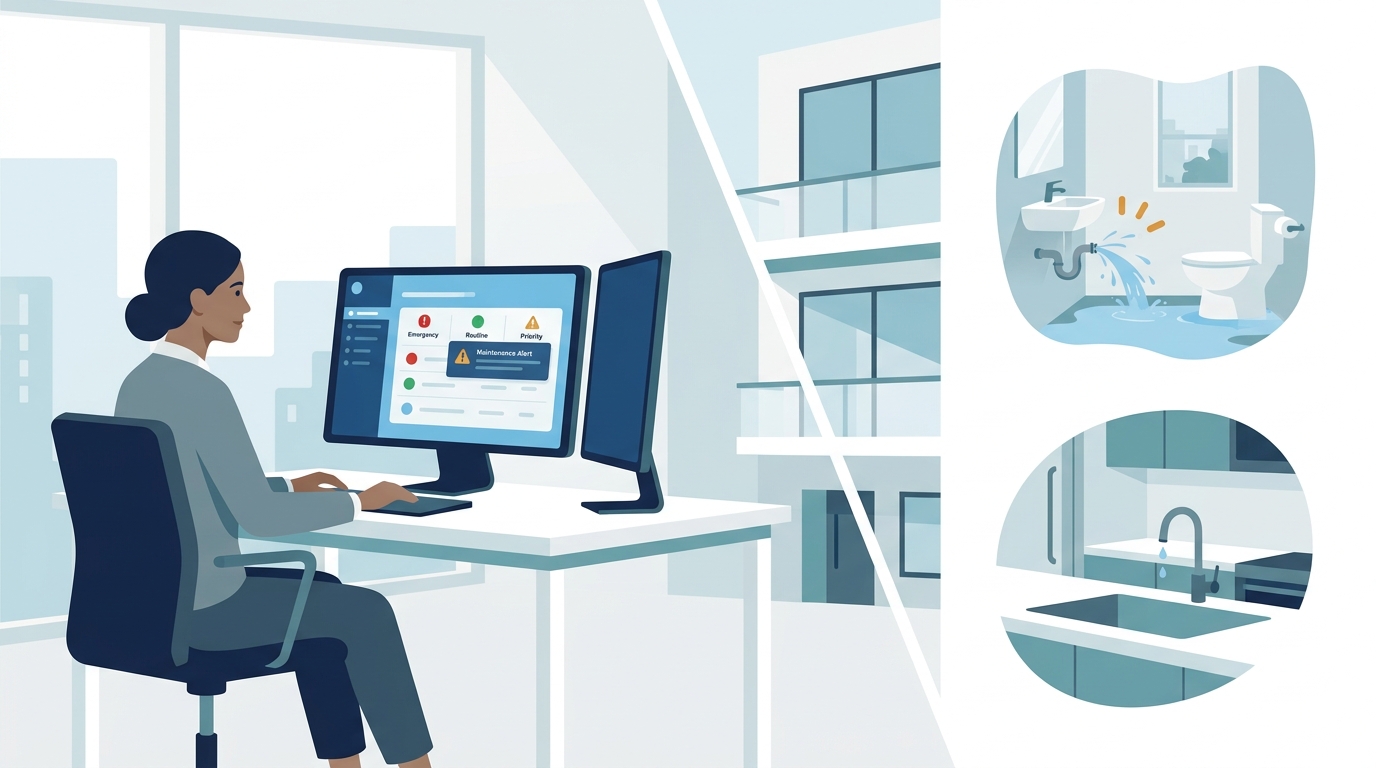
About 57% of rental inquiries land outside 9-to-5 — evenings, early mornings, and weekends. The leases are not lost because the renters vanish; they go cold because nobody answers in time. The fix is not more staff — it is instant, always-on response.
In conversations with property managers across the country, one pattern came up again and again: the owner answering Zillow inquiries from their phone at 10pm. These are residential operators running 50 to 300 units — managing everything from Gmail, no showing software, no one to hand it off to. The instinct is always "I need more help." But the data says the problem is not volume. It is timing. Most of those inquiries are not arriving when anyone is available to answer them.
Why do most rental inquiries arrive after hours?
Renters do not search for apartments on their lunch break. They search after dinner, before the morning commute, and on weekends — when they have time to actually look. Listing portals like Zillow, Apartments.com, and Facebook Marketplace are always on, so renters can browse and send inquiries at any hour. The expectation, increasingly, is that the response will be just as fast.
The channel shift reinforces this pattern. Fewer than 6% of new tenant leads now come from phone calls — renters self-serve on always-on listing portals and fire off a message when the listing catches their eye (industry analysis of US residential property managers). That moment almost never happens at 2pm on a Tuesday. It happens when they are off the clock, scrolling on their couch.
The result is a structural mismatch: the hours when renters are most active are the hours when property managers are least available.
What percentage of rental leads come in outside business hours?
56.8% of rental inquiries arrive outside traditional 9–5 business hours. Only 43.2% land Monday through Friday, 9am to 5pm. That is the finding from an industry analysis of US residential property managers' inquiry timing.
Call it nearly 6 in 10. Here is how the volume breaks down:
| Window | Share of all inquiries |
|---|---|
| Weekday 9am–5pm | 43.2% |
| Weekday evenings & early mornings (outside 9–5) | 34.3% |
| Weekends (Saturday & Sunday) | 22.5% |
The majority of your inbound leasing traffic is arriving when your office is dark.
[[cta]]
When exactly are renters reaching out — evenings, mornings, or weekends?
22.5% of all inquiries arrive on weekends, split roughly evenly between Saturday and Sunday. Among weekday leads, 44.2% fall outside the 9-to-5 window — and within that group, after-5pm inquiries are twice as common as before-9am ones (industry analysis of US residential property managers' inquiry timing).
That asymmetry matters. The gap is not the early morning — it is the evening. Weeknights after 6pm and the full weekend are the two windows where inquiry volume is highest and response rates are lowest. If you are trying to identify where leases are being left on the table, those are the hours to look at first.
What does after-hours leasing actually cost you in lost leases?
The cost is not the inquiry — it is the delay it forces. An 8pm inquiry that waits for a 9am reply has sat cold for 13 hours.
A landmark study from MIT's Dr. James Oldroyd and InsideSales.com (the Lead Response Management Study, 2007) put numbers to what happens during that wait: the odds of qualifying a web lead are 21 times higher when you respond within 5 minutes versus 30 minutes. The likelihood of even reaching the lead drops roughly 100 times over that same window. The original research covered B2B sales leads, but the underlying mechanism — response time determines whether a prospect is reachable and persuadable — applies wherever first-mover contact matters.
After-hours inquiries are exactly the leads that trigger this penalty. The 57% arriving off-hours are the same 57% most likely to go cold by morning — because they have had 8 to 13 hours to message two or three other listings and book a showing somewhere else. By the time your team opens the inbox, the decision has already been made.
How fast do you have to respond to win the lead?
Minutes, not hours. The renter who sends a message at 8pm is messaging three other properties at the same time.
Adjacent data points the same direction: in real-estate specifically — a closer comparison — 47% of homebuyers and 59% of home sellers hired the first agent they spoke with (Zillow Consumer Housing Trends Report, 2023). The pattern is consistent: first contact wins at a rate that makes response speed a competitive advantage, not just a nice-to-have.
The after-hours gap is not just lost leads. It is handing the first-responder advantage to whoever is available at 8pm — often a larger operator with automation already in place.
Why doesn't hiring more staff (or a VA, or an answering service) fix the after-hours gap?
The instinct to solve this with more people makes sense. But the economics do not work, and the quality often does not either.
- More headcount — nobody economically staffs 10pm on a Saturday to handle the thin tail of off-hours volume. You would pay for full overnight coverage in exchange for a fraction of your inquiry traffic.
- Overseas VAs or answering services — a consistent frustration among residential operators is inconsistent answers on specific units. A VA cannot tell a caller whether Unit 4B allows large dogs or what the current asking rent is. Generic answers are often worse than no answer, because they destroy confidence in the property.
- Voicemail and callback — this assumes renters still call. With phone calls now under 6% of new leads, a callback strategy misses the channel entirely. The renter who messaged on Zillow is not waiting for a phone call the next morning.
The structural answer is not more people covering more hours. It is response that does not depend on a person being available.
How do property managers cover inquiries 24/7 without working at 10pm?
The only thing that covers every window and hits the 5-minute response mark is automated, always-on response across text and voice — every inquiry answered in seconds, any hour, with correct unit-specific answers, and a showing booked in the same conversation.
LetHub does this for residential property managers: a 24/7 AI voice agent — Utter, LetHub's voice product, built to handle exactly this — combined with text response in roughly 30 seconds, answering leasing questions, qualifying renters, and booking ID-verified showings around the clock. The owner who was replying from their phone at 10pm no longer has to — every inquiry gets an immediate, accurate answer whether it arrives at 8am or midnight.
What does good after-hours inquiry handling look like?
Regardless of the tool, the standard to aim for is the same:
- Every inquiry gets a real answer in minutes, 24/7 — not "we'll get back to you" or a voicemail prompt.
- Answers are unit-specific and accurate — correct price, availability, and pet policy for the unit being asked about, not generic property information.
- The renter can book a showing in the same conversation, day or night, without a phone tag loop.
- Self-showings are ID-verified — always-on access should not mean scammers can tour vacant units unsupervised.
- It works across text and voice, since renters split between both channels and a text-only solution still misses voice inquiries.
That is the bar. It is achievable today, and it is what separates operators who capture the off-hours majority from those who consistently lose it.
Frequently Asked Questions
What percentage of rental inquiries come in after hours?
56.8% arrive outside traditional 9am to 5pm business hours, according to an industry analysis of US residential property managers' inquiry timing.
When do most renters send rental inquiries?
Evenings and weekends. After-5pm inquiries are twice as common as before-9am ones, and 22.5% of all inquiries land on Saturdays and Sundays (industry data on US residential property managers' inquiry timing).
How fast should you respond to a rental inquiry?
Within 5 minutes. The MIT Lead Response Management Study (2007) found that the odds of qualifying a web lead are 21 times higher when contacted within 5 minutes versus 30 minutes.
Why do after-hours rental leads go cold?
They wait until the next business morning while the renter has already messaged other listings. By the time your team opens the inbox, most of those renters have booked a showing elsewhere.
Does responding first actually win the lease?
Adjacent real-estate data suggests yes: 47% of homebuyers and 59% of home sellers hired the first agent they spoke with (Zillow Consumer Housing Trends Report, 2023).
Can't I just hire more staff or use an answering service to cover nights?
It is not economical for thin off-hours volume, and answering services often provide generic responses that cannot accurately address unit-specific questions — which can do more damage than no answer at all.
Do renters still call about rentals?
Rarely. Fewer than 6% of new tenant leads now come from phone calls — most renters self-serve on listing portals and send a text or online inquiry (industry data on US residential rental leasing patterns).
How can a small property manager cover inquiries 24/7?
Always-on automated text and AI voice response that answers unit-specific questions and books showings instantly, without staffing overnight.
[[cta2]]
The after-hours gap is a timing problem, not a staffing one. Nearly 6 in 10 rental inquiries arrive when your office is closed, and the leases go to whoever answers first — at any hour. See how LetHub answers every after-hours inquiry in roughly 30 seconds and books the showing for you — book a demo.
Leasing Automation Report

See LetHub on your own PMS and listings