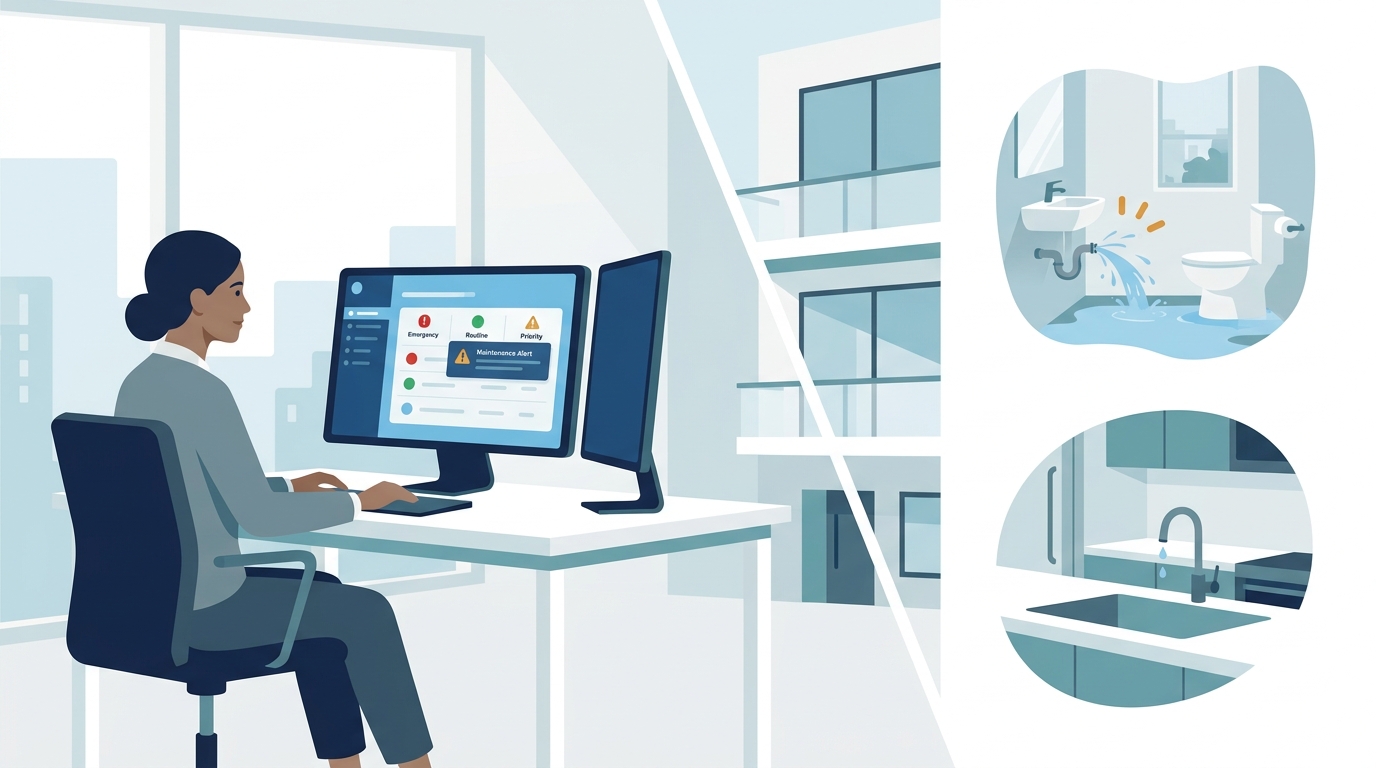
Only about 6.67% of maintenance requests are true emergencies, but those rare calls carry the most cost and all the liability. The job of a good after-hours system is to catch them: understand what the caller is describing, capture the details, and get a real emergency to a human fast — instead of logging a 2 a.m. flood for Monday alongside the leaky faucet that can wait.
Why the rare maintenance emergency is the one you can't afford to get wrong
Most maintenance calls are routine. Industry data from AppWork's work-order platform puts true emergencies at roughly 6.67% of all maintenance requests — everything else is a leaky faucet, a running toilet, or a cosmetic issue that can wait until morning. That's a small share of volume. But those calls carry an outsized share of cost. In Belong's 2025 analysis of more than 15,000 maintenance work orders, about 32% of repair costs were tied to emergency maintenance — burst pipes, HVAC failure, electrical hazards — a small fraction of tickets driving roughly a third of the spend, and nearly all of the liability.
In conversations with property managers across the US and Canada, one pattern shows up repeatedly: the owner or principal personally fielding the after-hours phone is one of the clearest signs they're ready to automate. The phone rings at 2 a.m. — they answer it, triage it themselves, call a vendor, and lose two hours of sleep for a dripping faucet. That's the trigger. The fear behind it isn't answering the call. It's the night a real flood, a gas leak, or a no-heat situation comes in and nobody picks up — logged for Monday instead of reaching a person right now.
Property managers already trying AI maintenance tools tell us they get roughly 80% of the way there. The gap is the last 20%: the night a real emergency comes in and never gets in front of a human in time. That's the problem an after-hours system has to solve — and it starts with a clear definition of what an emergency even is.
What separates a maintenance emergency from a routine request?
A workable rule: an emergency is anything that threatens safety, health, or the property if it waits until morning — fire, flooding, gas, no heat in the cold, no water. Everything else is routine. The clearer that line is for your properties, the faster anyone (or anything) answering the phone can route the call to the right place.
The clearest published framework for what counts as a maintenance emergency comes from the National Apartment Association's maintenance guidelines. The split looks like this:
| TRUE EMERGENCY — get a human now | ROUTINE — next business day |
|---|---|
| Fire → call 911 immediately | Leaky faucet or dripping tap |
| Water intrusion — burst pipe, flood, sewage backup | Running toilet |
| Gas leak or electrical failure | Appliance quirk (ice maker, disposal) |
| Loss of essential utilities — no heat or AC in extreme temperatures, no hot or cold water | Cosmetic issues (scuffs, stains, minor damage) |
| Non-working refrigerator | Single-fixture issues (one outlet, one light) |
Source: National Apartment Association (NAA) maintenance emergency guidelines.
The most useful version of this isn't a vendor's fixed judgment — it's a definition you write down for your portfolio. What counts as an emergency in a Phoenix summer (no AC) differs from a Winnipeg January (no heat), and your owner agreements may set their own bar. The value of writing it down: every call gets handled against the same standard, at 2 p.m. or 2 a.m. That documented, consistently applied standard is also the cleanest liability posture.
What should an after-hours system capture from a panicked caller at 2 a.m.?
Three things: acknowledge the caller, understand what the issue actually is, and capture the details so the right person can act. A caller reporting water coming through the ceiling needs to know they've been heard and that the information is going somewhere — not voicemail.
The "understand" part is what separates a useful intake from a dumb answering machine. There's a real difference between a system that takes a message — "maintenance issue, will call back" — and one that identifies the issue as water intrusion from the unit above, captures the unit, the access details, and the severity, and routes it accordingly. The first leaves whoever picks it up starting from zero. The second hands a human everything they need to decide and act.
For the genuinely dangerous categories — a suspected gas leak, an active fire — the safest standard is simple and worth building into any after-hours script or notice: tell people to leave and call 911, and get the call to a human immediately. The point of a good system at 2 a.m. is to make sure a real emergency reaches someone who can respond, not to leave the caller talking to a recording.
[[cta]]When should an after-hours call reach on-call vs. wait for the morning?
The decision is binary: does the request match your definition of an emergency? If yes, it needs to reach a human on your on-call path right away. If no, it can be logged, routed to the maintenance queue, and handled next business day.
A good after-hours setup also respects when you're actually available. During business hours, calls route one way. After hours, a different path kicks in — on-call notification, a transfer to your maintenance line or emergency vendor, or whatever you've configured. The routing follows your acceptance windows, not a guess.
The cost of getting this wrong runs in both directions. Treat everything as urgent and you've rebuilt the 2 a.m. phone problem — on-call staff burn out, vendors stop responding, and the real signal gets buried. Treat nothing as urgent and the flood gets logged for Monday. The entire value of an intake-and-routing layer is the correct split: the right calls reach the right people, every night, without the owner having to be the filter.
The liability behind a mishandled emergency: habitability in the US and Canada
This isn't just a service quality issue — it's a legal one. In the United States, the implied warranty of habitability attaches to every residential tenancy, whether written or oral. Landlords and property managers are required to maintain livable conditions — adequate heat, hot water, a structurally safe unit — and to address emergency conditions in a reasonable time. A 2 a.m. no-heat call ignored until Monday is a habitability exposure, not just an inconvenience.
Canada carries the same obligation. Every province and territory has residential tenancy legislation requiring landlords to address conditions that affect tenant health and safety promptly. The specifics vary by province, but the underlying standard — emergency habitability conditions must be handled without delay — is consistent coast to coast.
An after-hours system that reliably catches the real emergency and gets it to a human is a habitability and liability safeguard, not just a convenience feature. Consistent, documented handling of the right calls is also evidence of a reasonable response standard if a tenancy dispute ever arises.
Note: the above describes a general legal principle and is not jurisdiction-specific legal advice. Consult a licensed attorney for guidance on your obligations.
Where LetHub fits
LetHub's AI voice agent answers every maintenance call 24/7 — no voicemail, no missed after-hours contact. It doesn't just take a message: it understands the issue the caller is describing, logs the details, and transfers or routes the call the way you've set up — to your maintenance line, your emergency vendor, or your on-call staff — on your acceptance windows. A real after-hours emergency gets to a person instead of sitting in a voicemail box until Monday.
The agent syncs with your PMS so it has unit and owner context before the caller finishes their first sentence. It's part of LetHub's AI voice capability, powered by Utter — pay-as-you-go for the minutes you use, with no surprise overages.
[[cta2]]Frequently Asked Questions
What counts as a maintenance emergency vs. a routine request?
According to NAA guidelines, true emergencies are: fire (call 911), water intrusion such as a burst pipe or sewage backup, gas leak or electrical failure, loss of essential utilities (no heat or AC in extreme temperatures, no hot or cold water), and a non-working refrigerator. Everything else — leaky faucet, running toilet, appliance quirk, cosmetic issues — is routine and handled next business day.
What percentage of maintenance requests are actual emergencies?
Roughly 6.67% of maintenance requests qualify as true emergencies, per AppWork's work-order data. That's a small share of volume, but Belong's 2025 analysis of 15,000+ work orders found about 32% of repair costs trace to emergency maintenance — a fraction of tickets driving roughly a third of the spend, and nearly all of the legal liability.
Can an AI voice agent handle an after-hours maintenance call?
Yes — it answers 24/7, understands and categorizes the issue the caller describes, captures the details, and routes or transfers the call to the right place on your acceptance windows, so a real after-hours call reaches a human instead of voicemail. The decision standard — what's an emergency vs. routine — is yours; the system captures and routes against it.
Should I define my own emergency rules?
Yes. The most workable approach is a written definition of what counts as an emergency for your properties and geography — no AC in a hot climate, no heat in a cold one, your owner agreements' bar. A documented standard means every call is handled consistently at any hour, which is also the cleanest liability posture.
What should an after-hours system capture from a caller during a real emergency?
It should acknowledge the caller, understand and categorize what they're describing (e.g. water intrusion, no heat, a suspected gas leak), and capture the unit, access, and severity so a human can act. For dangerous categories like gas or fire, the safe standard is to tell the caller to leave and call 911, and get the call to a person immediately.
Is mishandling an emergency call a legal risk?
Yes. The US implied warranty of habitability and Canadian provincial residential tenancy legislation both require that emergency conditions affecting tenant health and safety be addressed in a reasonable time. Ignoring or failing to surface a real emergency is a habitability exposure, not just a service failure. (General principle — not legal advice.)
Does an AI voice agent replace my on-call staff?
No — it filters. It answers and captures every call, routes the routine ones that don't need to wake anyone, and gets the urgent ones to your on-call path fast. On-call staff end up handling the calls that actually matter, which reduces burnout and improves response on the cases that count.
Does it work for both US and Canadian property managers?
Yes. The emergency definition and the habitability obligation apply in both markets — US warranty of habitability and Canadian provincial residential tenancy legislation carry the same standard. LetHub syncs with major PMSs and serves property managers across the US and Canada, including operators who run Yardi for accounting and LetHub for leasing.
The maintenance call that comes in at 2 a.m. is the test of your after-hours system — whether it gets the real emergency to a human or buries it in a voicemail box. Book a demo to see how LetHub's AI voice agent answers, understands, and routes after-hours maintenance calls — the routine ones and the ones that matter.
Leasing Automation Report

See LetHub on your own PMS and listings